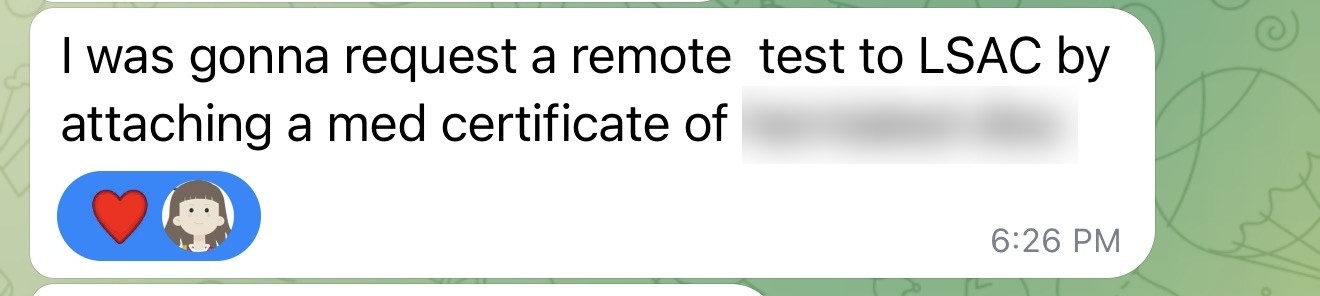
A customer messaged me with this plan:
"I was gonna request a remote test to LSAC by attaching a med certificate of a back injury"
Good question, and the timing matters, because how you take the LSAT is changing. Here is the straight version, no fluff.
What changed with the LSAT
Right now, through the 2025-2026 testing year, you get to choose. You can take the LSAT online, live remote-proctored from home, or in person at a Prometric test center. You do not need a reason to pick remote.
From the August 2026 LSAT, that changes. LSAC is moving the multiple-choice part of the test into Prometric centers for almost everyone. Remote does not disappear, but it stops being a free choice and becomes something you have to qualify for. The reason LSAC gives is test security, and specifically organized remote-cheating operations.
One caution on dates. A lot of prep sites say June 2026 is the last freely optional remote LSAT. LSAC itself only says the change takes effect with the August 2026 administration, so treat the exact "last remote date" as an inference, not an official line.
The ways remote is still allowed
After August 2026, remote testing comes down to four exceptions. If you fit one, you can still test from home.
Medical or disability accommodation that requires remote testing. This is the back-injury route, and the one most people can actually use. More on it below.
Distance. If you live more than 180 miles, or about 3 hours' drive, from an available test center with capacity, you can request a distance exception.
Active military stationed abroad. Service members posted overseas, plus their spouses and dependents, qualify under LSAC's military policy.
Test center closure. If your assigned center closes for weather or another unforeseen reason, remote can be offered as the fallback.
The medical route, step by step
This is the plan the customer described, so here is how it actually works.
A back injury counts. LSAC recognizes temporary disabilities, not only permanent ones, and something that stops you sitting through a multi-hour test fits that.
Here is the part people miss. Getting accommodations is not the same as getting remote. You can be approved for extra time and extra breaks and still be told to show up at a center. To test from home, your documentation has to argue that remote delivery itself is necessary, not just that you need breaks. Make that the point of the request, in writing.
What you file: the Evidence of Disability form, plus a Qualified Professional Form completed by a licensed professional who has treated you. You submit both through "Request or Modify Accommodations" in your JD Services account, under LSAT.
What the documentation has to show: the condition, how it limits you in a real testing setting, and why remote is the accommodation that meets that need.
While you are at it, you can also request the sit-tolerance accommodations that help with a bad back: extended time, usually 50 percent or 100 percent more, extra breaks, and up to 60 minutes of stop-clock break time across the day that you can spend standing and stretching. One honest note. A standing desk or sit-stand desk is not a named accommodation LSAC publishes, so do not build your plan around getting one. The supported path for not being able to sit is extra time plus stop-clock breaks.
Deadline matters more than anything else here. All of your documentation has to reach LSAC by the accommodation deadline for your test date, and LSAC states there are no exceptions to it. Start weeks early, because getting a doctor to fill out forms is the slow part.
What a remote LSAT actually involves now
If you get the exception, know what you are signing up for, because remote proctoring is strict.
The multiple-choice test runs through Prometric's ProProctor software. The separate writing sample runs through ProctorU. For the main test you need a government photo ID, a live human proctor, and a full 360-degree scan of your room including under the desk. You need an external webcam with your head and shoulders in frame the whole time, and a smartphone set up as a required second camera.
The room has to be private and fully enclosed, no glass walls, no cubicle. No other people, pets, devices, or extra monitors. No VPN, no incognito, no phone hotspot at any point. It runs on Windows or macOS only, no Chromebooks or tablets.
Where we fit
The exception is paperwork. You file the forms, you get the remote sitting approved, and that part is on you and your doctor. What you do with that remote sitting is the part we handle. If that is where you are headed, see how we take the LSAT for you.
Official references
Everything above comes from LSAC's own pages. Check them directly, because the policy is mid-transition and details can move.
- LSAT Remote Testing and Distance Exceptions: the exception categories after August 2026, covering the medical, distance, military, and closure routes.
- Getting Ready for Your Remote LSAT: remote setup rules, including ID, room scan, webcam, second camera, and network restrictions.
- Getting Ready for Your LSAT at a Test Center: the in-center Prometric format most people move to.
- FAQs About the LSAT: the current-cycle choice between remote and a test center.
- LSAT Accommodations: the accommodations overview and the note on the August 2026 move to in-center testing.
- Accommodations That May Be Available on the LSAT: extended time, extra breaks, stop-clock breaks, and what is permitted without a request.
- How to Request Accommodations on the LSAT: the JD Services process and deadlines.
- Documentation Requirements: what your medical documentation has to include, with the current Qualified Professional Form.
- FAQs About LSAT Accommodations: temporary conditions, re-requests, and the no-exceptions deadline.
- Evidence of Disability form (PDF): the form itself.